
If you run a bakery, deli, grocery store, or specialty food business, you have almost certainly encountered both pinch bottom bags and SOS bags. Both are widely used food packaging formats — but they have distinct structural differences that make each better suited to specific applications.
Choosing the wrong format can lead to bags that are difficult to fill, unstable on shelves, or unsuitable for your specific food products. This guide compares pinch bottom and SOS bags across the factors that matter most for food businesses.
What Is a Pinch Bottom Paper Bag?
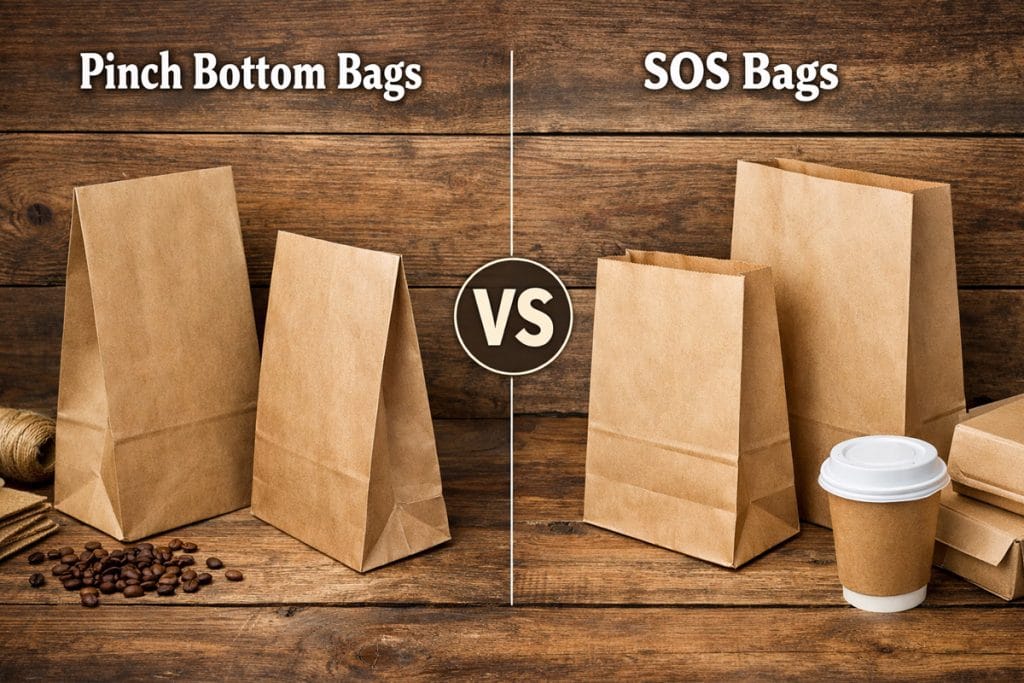
A pinch bottom bag (also called a bakery bag or pinch-sealed bag) has its bottom sealed with a flat pinch fold — the paper is folded and crimped together at the base, creating a sealed bottom without a separate base insert or glued square base.
The resulting bag is more cylindrical or conical in shape when empty, and expands slightly when filled. Pinch bottom bags are the classic bakery bag — the format used for baguettes, croissants, pastries, sandwiches, and most baked goods.
Types of Pinch Bottom Bags
- ● Standard pinch bottom: Plain or printed, for general bakery and food use
- ● Window pinch bottom: With clear OPP window for product display — our Bakery Bags With Window are particularly popular for artisan bread and pastry display
- ● Triangle pinch bottom: Triangular shaped for sandwiches, pastries, and snacks — our Triangle Oil Proof Paper Bags offer unique stability and presentation
- ● Grease-proof pinch bottom: With oil-resistant coating for fried foods, pastries, and any greasy food application

Pinch bottom bags (left) suit baked goods; SOS bags (right) suit heavier grocery and bulk items
What Is an SOS Paper Bag?
An SOS (Self-Opening Satchel) bag has a flat, square, glued bottom that allows it to stand upright independently. This self-standing feature makes SOS bags significantly easier to fill and more stable when displayed or stacked on shelves.
SOS bags are standard in grocery stores, delis, and specialty food retail. They are available in our range of SOS Paper Bags including brown and white kraft, with tin-tie closures and OPP window options.
Head-to-Head Comparison
| Factor | Pinch Bottom Bags | SOS Bags |
|---|---|---|
| Bottom Structure | Pinch-sealed — no separate base | Flat, glued square base |
| Self-Standing | No — must be leaned or held | Yes — stands upright independently |
| Ease of Filling | Moderate — requires holding open | Excellent — self-opens and stands |
| Best For | Bread, pastries, baked goods | Grocery, bulk foods, coffee, flour |
| Resealable Option | No (unless tin-tie added) | Yes — tin-tie available |
| Window Option | Yes | Yes |
| Cost | Slightly lower | Slightly higher due to square base |
Which Should You Choose?
Choose Pinch Bottom Bags If:
- ● You are packaging baked goods — bread, pastries, croissants, rolls
- ● You need a lighter-weight bag for items that do not require a stable base
- ● Cost efficiency is a priority for high-volume bakery operations
- ● You want a window to display product attractively on a counter or shelf
Choose SOS Bags If:
- ● You need the bag to stand upright for easy filling in a high-volume environment
- ● You are packaging coffee, flour, tea, or other resealable products (tin-tie)
- ● You are a grocery store or deli where stability and consistent presentation matter
- ● You need a larger range of sizes for different product categories
Many food businesses use both formats — pinch bottom bags for bakery counter service and SOS bags for retail shelf display or packaged goods. Browse our complete Food-Grade Paper Bags range to find the right combination for your operation.
Ready to Order Custom Paper Bags?
Nextgen Paper Bags manufactures directly from China and ships to the USA, Canada, and Europe. Get factory-direct pricing with full customization.